

The best Shopify SEO tools are Google Search Console, Semrush, Ahrefs, Plug In SEO, SEO Manager, Smart SEO, Yoast SEO, Google Analytics 4, Screaming Frog, and Google Page Speed Insights.
These tools help Shopify store owners find profitable keywords, fix technical SEO issues, optimize product and collection pages, monitor rankings, analyze competitors, and increase organic sales.
However, tools alone don’t improve rankings.
The Shopify stores that consistently grow organic traffic use SEO tools to make better decisions, identify opportunities faster, and focus their efforts where they will have the biggest impact on revenue.
If you’re wondering which Shopify SEO tools are actually worth using and which ones are just adding noise , this guide breaks down the best options based on real ecommerce use cases, not marketing hype.
Why Shopify Stores Need SEO Tools
Shopify stores need SEO tools because they help identify keyword opportunities, fix technical issues, analyze competitors, improve page performance, and increase organic traffic that can lead to more sales.
While Shopify provides a strong SEO foundation, it doesn’t tell you which keywords to target, why competitors outrank you, or what is preventing important pages from performing in search results.
While SEO tools provide valuable data, understanding how to do SEO for Shopify is what ultimately drives rankings and sales.
Many store owners invest in tools first, but a structured Shopify SEO is what that turns keyword data and technical insights into measurable organic growth.
Shopify handles many SEO fundamentals well.
You get a mobile-friendly platform, secure hosting, fast infrastructure, customizable metadata, and a search-engine-friendly framework right out of the box.
Yet thousands of Shopify stores still struggle to rank competitively.
That’s because SEO success isn’t determined by the platform alone. It’s determined by how effectively you understand search demand, optimize content, improve technical performance, and respond to market competition.
This is where Shopify SEO tools become valuable.
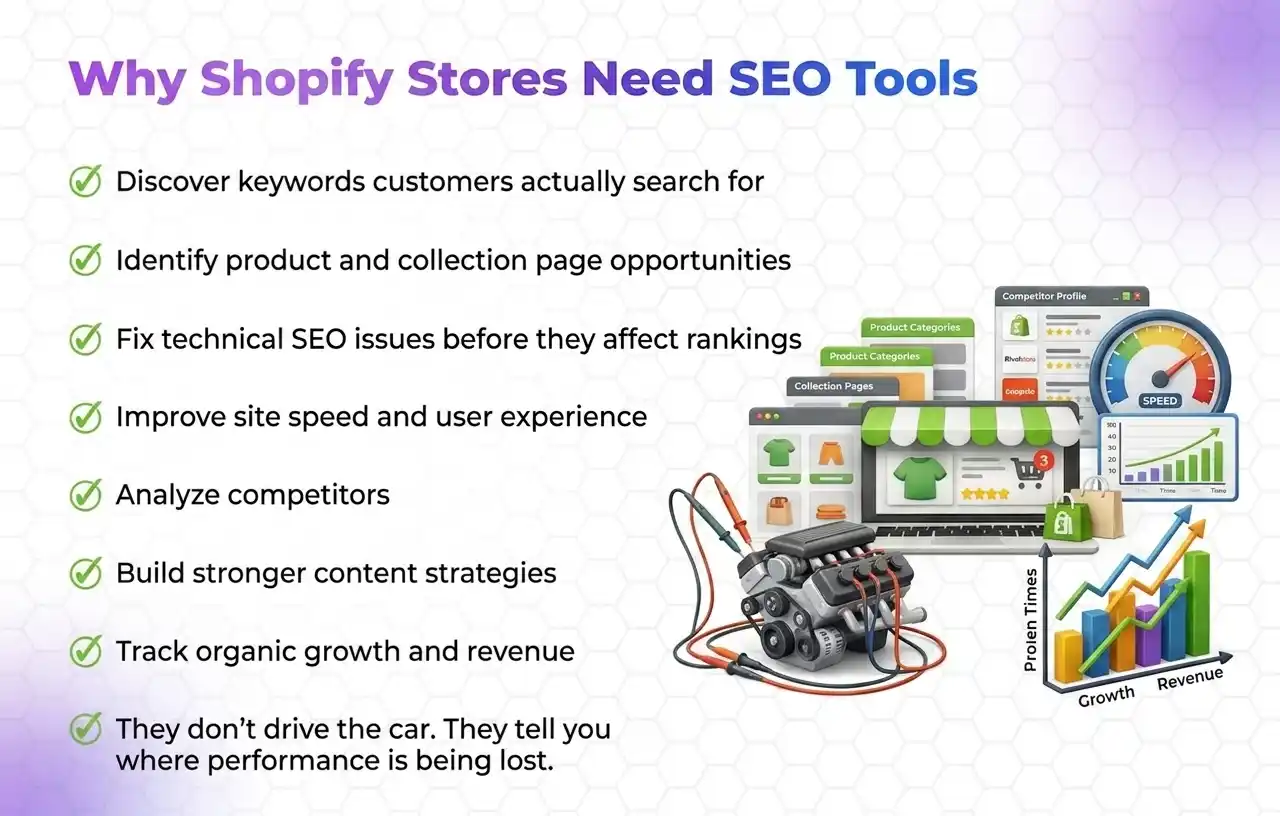
They help you:
- Discover keywords customers actually search for
- Identify product and collection page opportunities
- Fix technical SEO issues before they affect rankings
- Improve site speed and user experience
- Analyze competitors
- Build stronger content strategies
- Track organic growth and revenue
Best Shopify SEO Tools at a Glance
If you’re looking for the fastest answer, here’s our recommendation.
| Goal | Recommended Tool |
|---|---|
| Best Free Shopify SEO Tool | Google Search Console |
| Best Keyword Research Tool | Semrush |
| Best Competitor Analysis Tool | Ahrefs |
| Best Shopify SEO App | Plug In SEO |
| Best SEO Automation Tool | Smart SEO |
| Best Content Optimization Tool | Yoast SEO |
| Best Analytics Tool | Google Analytics 4 |
| Best Technical SEO Tool | Screaming Frog |
| Best Speed Optimization Tool | Google PageSpeed Insights |
| Best Overall Shopify SEO Stack | Search Console + Semrush + Shopify SEO App |
For most stores, this combination provides everything needed to improve visibility, rankings, and conversions.
10 Best SEO Tools for Shopify Stores
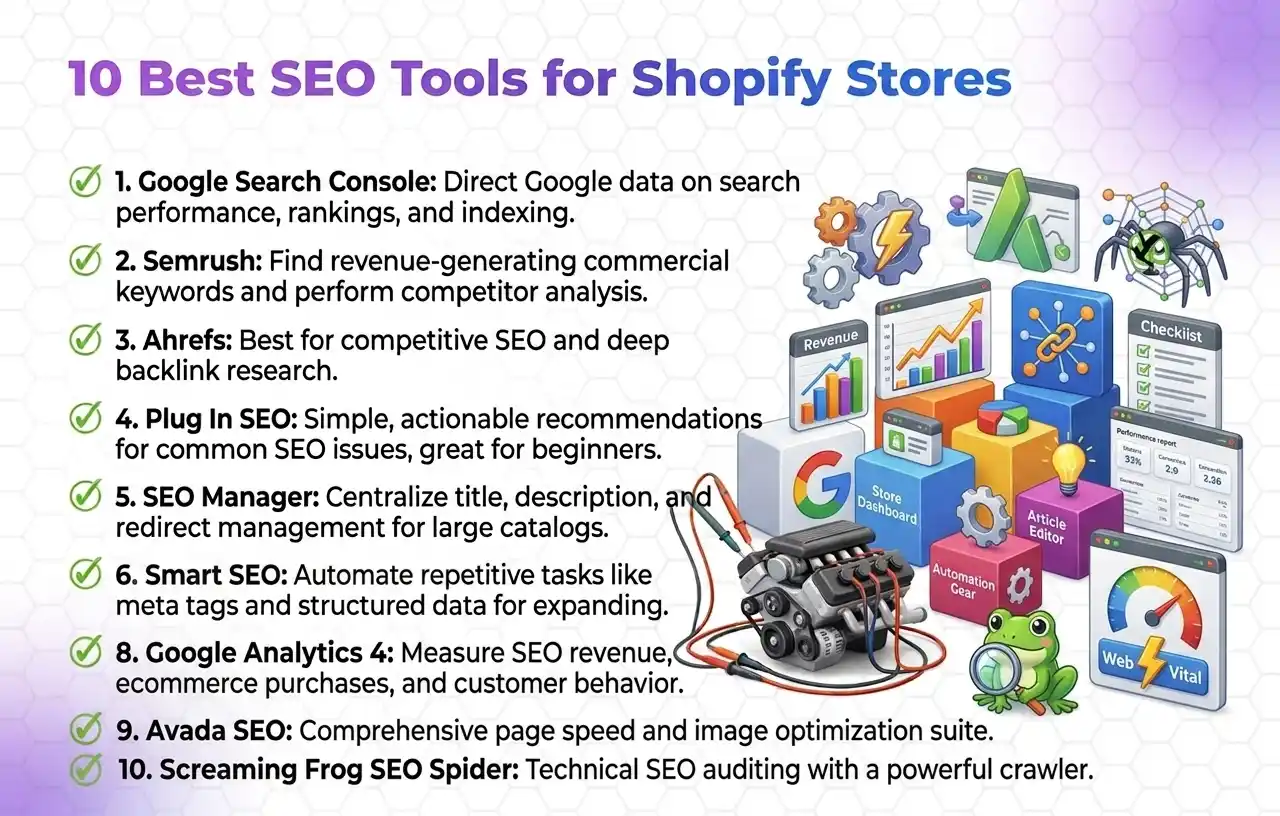
1. Google Search Console : The Most Important SEO Tool for Shopify
If you only install one SEO tool, make it Google Search Console.
Unlike third-party software, Search Console provides data directly from Google. It shows how your Shopify store performs in search results and where opportunities exist to improve visibility.
With Search Console, you can:
- Monitor impressions and clicks
- Track ranking positions
- Identify indexing issues
- Discover high-performing pages
- Analyze search queries
- Review Core Web Vitals
- Find technical SEO problems
One of the biggest advantages is discovering keywords you’re already close to ranking for.
Instead of chasing new opportunities, you can often achieve faster gains by improving pages already appearing on page one or page two.
2. Semrush : Best for Finding Revenue-Generating Keywords
Many Shopify stores don’t have a traffic problem.
They have a targeting problem.
They’re creating content around keywords that don’t generate sales or competing for terms that are too difficult to rank for.
Semrush helps solve that challenge.
It allows you to:
- Research commercial keywords
- Analyze competitors
- Discover content opportunities
- Track rankings
- Audit websites
- Identify keyword gaps
- Monitor backlinks
Instead of guessing what customers search for, you can build content and SEO campaigns around actual demand.
One of the most powerful features is competitor analysis.
You can see which keywords drive traffic to competing stores and identify opportunities they’re already benefiting from.
3. Ahrefs : Best for Competitive SEO and Backlink Research
If Semrush helps you understand search opportunities, Ahrefs helps you understand why competitors outperform you.
Ahrefs is widely regarded as one of the strongest backlink and competitor analysis tools available.
It helps Shopify merchants:
- Analyze backlinks
- Discover content gaps
- Research keywords
- Track rankings
- Monitor competitors
- Find link-building opportunities
Backlinks remain one of Google’s strongest ranking signals.
Ahrefs makes it easier to understand where competitors earn links and which pages attract the most authority.
For stores entering competitive markets, this information can significantly influence content and SEO strategy
4. Plug In SEO : Best Shopify SEO App for Beginners
Plug In SEO is designed specifically for Shopify merchants who want clear, actionable recommendations without needing advanced technical knowledge.
The platform scans your store and highlights common SEO issues such as:
- Missing metadata
- Broken links
- SEO errors
- Performance concerns
- Structured data opportunities
What makes it useful is simplicity.
Rather than overwhelming merchants with technical jargon, it focuses on practical improvements that can be implemented quickly.
5. SEO Manager : Best for Managing Store-Level SEO
As a Shopify store grows, SEO becomes harder to manage manually.
SEO Manager helps centralize many optimization tasks in one place.
It can support:
- Meta title management
- Meta descriptions
- Redirect monitoring
- Structured data improvements
- SEO monitoring
For stores managing hundreds of products and collections, maintaining consistency becomes increasingly important.
SEO Manager simplifies that process.
6. Smart SEO : Best for Automation
Automation becomes increasingly valuable as product catalogs expand.
Smart SEO helps automate repetitive tasks including:
- Meta tags
- Structured data
- Image optimization
- SEO metadata generation
For stores with hundreds or thousands of products, automation can save significant time.
However, important commercial pages should still receive manual optimization.
The goal is to automate repetitive work while maintaining strategic control over pages that drive revenue.
7. Yoast SEO : Best for Shopify Content Marketing
Content marketing remains one of the most effective ways to grow organic traffic.
Yoast SEO helps optimize content for both search engines and readers.
It provides guidance around:
- Readability
- Keyword targeting
- Metadata
- Internal linking
- Content structure
This makes it particularly useful for Shopify brands investing in blog content, buying guides, comparison articles, and educational resources.
8. Google Analytics 4 : Best for Measuring SEO Revenue
Traffic is not the goal.
Revenue is.
Google Analytics 4 helps Shopify businesses understand what happens after visitors arrive on the website.
It helps measure:
- Organic traffic
- User engagement
- Ecommerce purchases
- Conversion paths
- Revenue attribution
- Customer behavior
Combined with Search Console, Analytics provides a complete picture of SEO performance.
Search Console shows how users find your website.
9. Screaming Frog : Best for Technical Shopify SEO
Technical SEO issues can quietly hold back even the best ecommerce stores.
Screaming Frog helps uncover problems at scale.
It can identify:
- Broken links
- Redirect chains
- Duplicate content
- Missing metadata
- Indexability issues
- Canonical problems
- Internal-linking opportunities
For larger Shopify websites, manual audits become impractical.
A crawler provides visibility into issues that may otherwise go unnoticed.
10. Google PageSpeed Insights : Best for Site Performance
Page speed affects user experience, engagement, and conversions.
Google PageSpeed Insights helps Shopify merchants understand how their website performs across mobile and desktop devices.
It evaluates:
- Core Web Vitals
- Loading speed
- Performance bottlenecks
- User experience metrics
Common issues include:
- Large product images
- Excessive apps
- Heavy scripts
- Unoptimized themes
The goal isn’t chasing a perfect score.
The goal is creating a fast shopping experience that supports conversions.
Which Shopify SEO Tool Is Best for Your Store?
The answer depends on where your store is today.
New Shopify Store
Start with:
- Google Search Console
- Google Analytics 4
- Plug In SEO
This combination provides the essential data needed to build a strong SEO foundation.
Growing Shopify Store
Use:
- Google Search Console
- Semrush
- Shopify SEO App
This stack helps identify growth opportunities while maintaining store health.
Established Ecommerce Brand
Consider:
- Google Search Console
- Semrush
- Ahrefs
- Screaming Frog
This combination provides advanced keyword research, technical SEO insights, and competitive intelligence.
Content-Driven Shopify Brand
Use:
- Semrush
- Yoast SEO
- Google Search Console
Ideal for brands relying on blogs, buying guides, and informational content.
The Common Shopify SEO Mistake
Most Shopify stores don’t fail because they lack SEO tools.
They fail because they focus on tools instead of execution.
We’ve reviewed stores paying for multiple SEO platforms while still struggling with:
- Thin collection pages
- Poor internal linking
- Weak keyword targeting
- Duplicate product content
- Slow page speed
- Missing content strategy
The issue wasn’t software.The issue was implementation.
The best-performing Shopify stores use tools to uncover opportunities, then consistently act on those insights.That’s where real growth happens.
How Shopify SEO Tools Help Increase Sales
SEO tools don’t directly generate revenue.They help create the conditions that make revenue growth possible.
Better Keyword Targeting
Reach customers actively searching for your products.
Improved Product Visibility
Optimize product and collection pages for search intent.
Better User Experience
Identify performance and technical issues that affect conversions.
Stronger Content Strategy
Create content that attracts customers at every stage of the buying journey.
Competitive Advantage
Understand what competitors are doing well and where opportunities exist.
Better Decision Making
Replace assumptions with real search and performance data.
Over time, these improvements compound.
Behind every high-revenue store is a successful ecommerce SEO campaign, where every optimization effort is aligned with buyer intent and revenue goals.
Our Recommended Shopify SEO Tool Stack
If we were launching a Shopify store today, this is the setup we’d choose.
Essential Free Stack
- Google Search Console
- Google Analytics 4
- Google PageSpeed Insights
Best Growth Stack
- Search Console
- Semrush
- Plug In SEO
Advanced Ecommerce Stack
- Search Console
- Semrush
- Ahrefs
- Screaming Frog
- Smart SEO
This approach avoids unnecessary costs while ensuring every important SEO area is covered.
FAQs
What is the best SEO tool for Shopify?
Google Search Console is the most important free Shopify SEO tool because it provides direct insight into search performance, indexing, rankings, and visibility.
Does Shopify have built-in SEO tools?
Yes. Shopify includes editable metadata, SEO-friendly architecture, mobile responsiveness, SSL security, and several built-in optimization features. Advanced SEO typically requires additional tools.
Is Semrush good for Shopify SEO?
Yes. Semrush is one of the best tools for keyword research, competitor analysis, content planning, rank tracking, and SEO strategy.
Is Ahrefs better than Semrush?
Neither tool is universally better. Ahrefs excels at backlink analysis and content-gap research, while Semrush offers a broader SEO and marketing toolkit.
Are Shopify SEO apps worth it?
For many merchants, yes. Shopify SEO apps simplify optimization tasks, improve efficiency, and help identify issues that might otherwise be missed.
Final Verdict
The best Shopify SEO tools aren’t necessarily the most expensive ones.
For most stores, Google Search Console, Semrush, and a dedicated Shopify SEO app provide the strongest balance of insights, optimization capabilities, and growth opportunities.
The key isn’t collecting more software.
The key is using the right tools to identify what matters most, then acting on those insights consistently.
Because in ecommerce SEO, the stores that win aren’t the ones with the biggest tool stack.They’re the ones that make the best decisions.
Ready to Grow Your Shopify Store Organically?
Choosing the right SEO tools is only the first step. Turning those insights into higher rankings, qualified traffic, and consistent sales requires a clear strategy and ongoing optimization.
At The Meta Future, our Shopify SEO Services help ecommerce brands turn SEO insights into sustainable organic growth.
👉 Explore our Shopify SEO Services and start building a stronger organic growth strategy today.