


Launching or scaling a Shopify store sounds simple on the surface. Pick a theme, upload products, connect payments, and go live.
Reality looks very different. A serious ecommerce brand quickly discovers that design decisions influence conversions, performance affects ad ROI, and technical structure impacts SEO. That’s exactly where a Shopify development agency enters the picture.
We’ve worked with startups launching their first online store and established brands migrating from platforms that were slowing them down.
The difference between a store that simply “exists” and one that consistently sells usually comes down to how strategically the site was built.
Choosing the right team is less about credentials on a website and more about how they think, how they solve problems, and how deeply they understand ecommerce behavior.
This article breaks down what actually matters when selecting the right partner.
What Is a Shopify Development Agency?
A Shopify development agency specializes in designing, building, customizing, and optimizing online stores on Shopify. The work usually goes far beyond installing a theme.
The real job involves structuring a store so customers move smoothly from curiosity to purchase.
Think of it as a blend of technology, design, and ecommerce psychology.
Many businesses initially hire a freelancer to “set up Shopify.” The site goes live quickly, but growth stalls. Product pages don’t convert well, page speed drops when traffic increases, and integrations start breaking when marketing tools are added.
That’s usually the moment brands begin looking for a more structured partner.
A professional Shopify web development agency focuses on solving these deeper challenges.
From the outside, the work might look like simple development tasks. Behind the scenes, it often includes:
- Conversion-focused page architecture
- UX improvements for product discovery
- Checkout optimization
- Mobile performance improvements
- Custom features tailored to business needs
We’ve seen many founders come to us after launching their first store using a generic template. Their traffic looked decent, but sales remained unpredictable. Once the site structure was rebuilt around storytelling and product clarity, conversions began stabilising.
A Shopify ecommerce development agency essentially helps translate business goals into a digital storefront that works reliably under real market conditions.
In practical terms, that means combining design logic, development precision, and ecommerce strategy.
How to Evaluate Shopify Development Agency Expertise?
This is where most businesses get tripped up. They look at an agency’s homepage, see some recognisable brand logos, and make a decision based on surface-level signals.
That’s understandable, but it’s a shortcut that often leads to mismatched partnerships and disappointing projects.
Verified Client Reviews
The first thing to look at seriously is verified client reviews, not just the testimonials on the agency’s own website.
Every agency curates their own testimonials, that’s marketing, not evidence. What you want are reviews on independent platforms like Clutch, Google, and the Shopify Partner Directory.
Look for patterns across reviews, not just ratings. Do clients consistently mention clear communication and on-time delivery? Or are there threads about missed milestones, vague timelines, and unresponsive support after handover?
Ten perfect reviews mean far less than fifty mixed ones with detail, because the detail tells you what actually happens when things get complicated.
Case Studies
Case studies are the second major filter, and the standard for a useful case study is simple: problem, approach, result, with real numbers.
An agency saying they “improved conversions” for a client is meaningless without context.
Did they improve a 0.5% conversion rate to 1.8%? Did they cut page load time from 8 seconds to 2.1 seconds? They migrate a 10,000-product Magento catalogue to Shopify in six weeks with zero data loss?
Those are the kinds of specifics that tell you an agency understands what they’re being measured on.
We pay close attention to this when we assess potential partners, because an agency that doesn’t measure its own outcomes is unlikely to be focused on measuring yours.
Technical Depth
Technical depth in 2026 looks different from what it did three years ago. Shopify has changed significantly.
Agencies now need genuine fluency in Checkout Extensibility (replacing the old checkout.liquid model), Hydrogen for headless builds, modern app architecture, and B2B logic.
When evaluating an agency, ask directly: have they built with Checkout Extensibility? Do they have Hydrogen experience? Can they handle ERP and CRM integrations? How do they approach Core Web Vitals optimisation?
Agencies that are current on Shopify’s evolution will answer these questions fluently. Agencies that are running on outdated knowledge will hedge or redirect.
Communication And Process
Communication style and process transparency are indicators that are easy to dismiss as soft criteria but turn out to be significant in practice.
Ask every agency the same questions: what does your project kickoff process look like? How do you handle scope changes? What does a typical weekly update look like? How do you handle bugs discovered after launch?
The answers reveal how structured they are, how they manage client expectations, and whether they have a genuine process or are improvising project by project.
For businesses in Dubai and the MENA region where time zone alignment and response speed matter, an agency’s communication infrastructure is a practical as well as cultural consideration.
Post-Launch Support
Finally, the post-launch support offering is something too many businesses forget to evaluate during the selection process, only to regret it six weeks after launch when a payment gateway integration breaks on a peak sales day.
A strong Shopify development agency doesn’t disappear after handover. They should offer structured maintenance retainers, a clear process for reporting and resolving post-launch issues.
Moreover, they must ideally offer an ongoing optimisation programme, A/B testing, performance monitoring, seasonal campaign support, that helps the store improve continuously rather than just running on autopilot.
What Services Does a Shopify Development Agency Offer?
The scope of what a full-service Shopify ecommerce development agency provides is broader than most clients initially expect, and understanding the full range helps you assess whether an agency can serve your needs beyond the initial build.
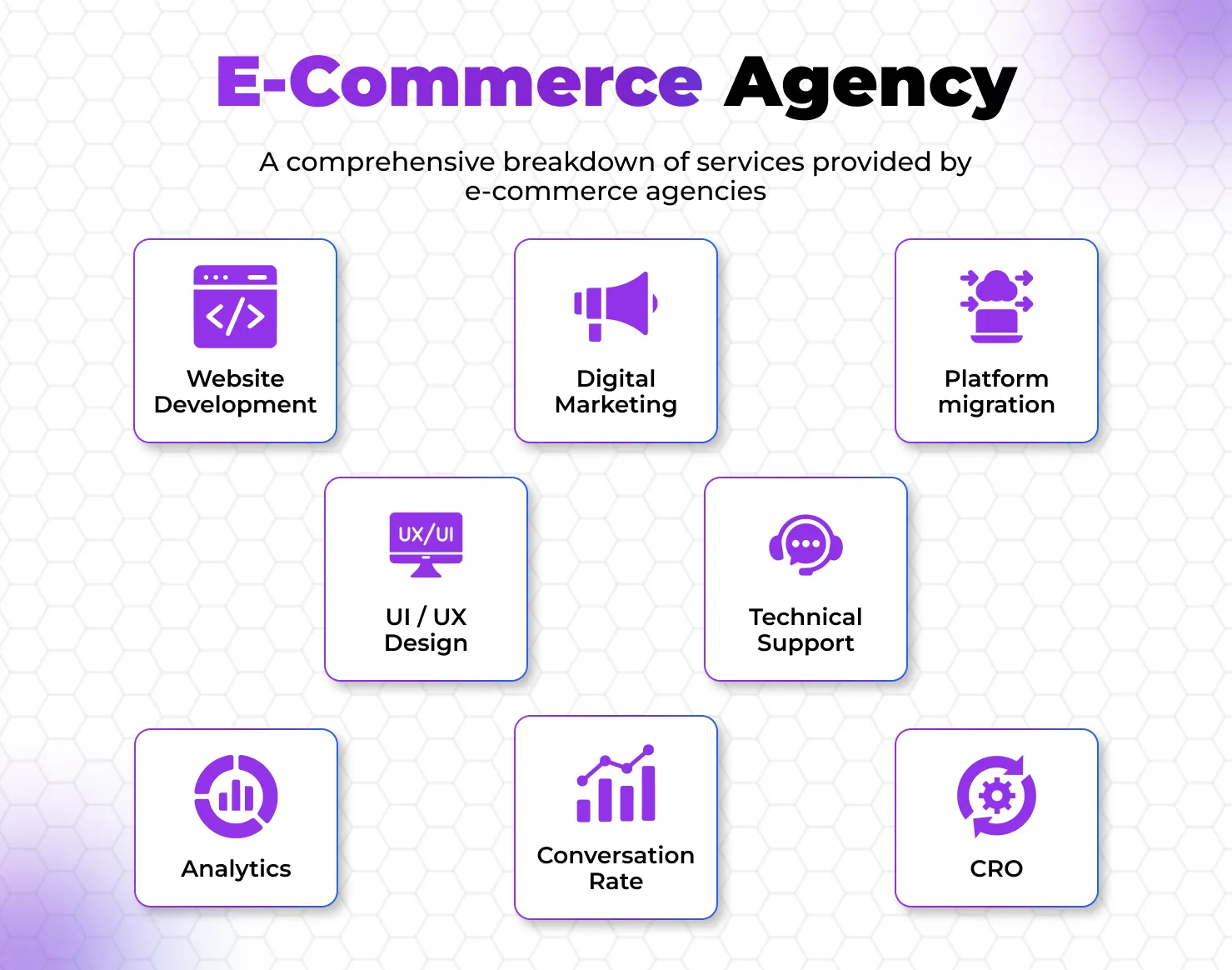
The services offered by a Shopify development agency usually span several areas. Some agencies specialize in design, while others handle the full ecommerce lifecycle.
Understanding these services helps businesses decide whether an agency aligns with their needs.
Store Setup and Configuration
Many brands start with foundational services.
This includes:
- Shopify store setup
- Payment gateway configuration
- Product catalog structure
- Shipping rules and tax settings
Although these tasks sound basic, their structure influences the long-term scalability of the store.
A good Shopify ecommerce development agency ensures that the store architecture supports future expansion.
Custom Design and User Experience
Design determines how customers perceive the brand within seconds.
A specialized Shopify website design company focuses on:
- Product page hierarchy
- Mobile-first layouts
- Navigation clarity
- Visual storytelling
We often redesign product pages to emphasize benefits before technical specifications. That small shift often improves engagement dramatically.
Theme Customization
Most brands start with a theme but need adjustments to match their identity.
Theme customization includes:
- Layout modifications
- Custom sections
- Advanced product displays
- Interactive elements
The difference between basic customization and strategic design is how well the store communicates the product’s value.
Shopify App Integration
Modern ecommerce stores rely heavily on apps for marketing automation, reviews, subscriptions, analytics, and inventory management.
A reliable Shopify app development company can build custom applications when existing tools cannot solve a problem effectively.
Custom integrations often include:
- CRM connections
- inventory automation
- subscription workflows
- advanced analytics dashboards
Performance Optimization
Speed affects conversion rates more than most brands realize.
Many agencies offering Shopify web development services focus heavily on performance optimization, including:
- code refinement
- image optimization
- script management
- server response improvements
These technical improvements often reduce bounce rates significantly.
How to Choose the Best Shopify Development Agency?
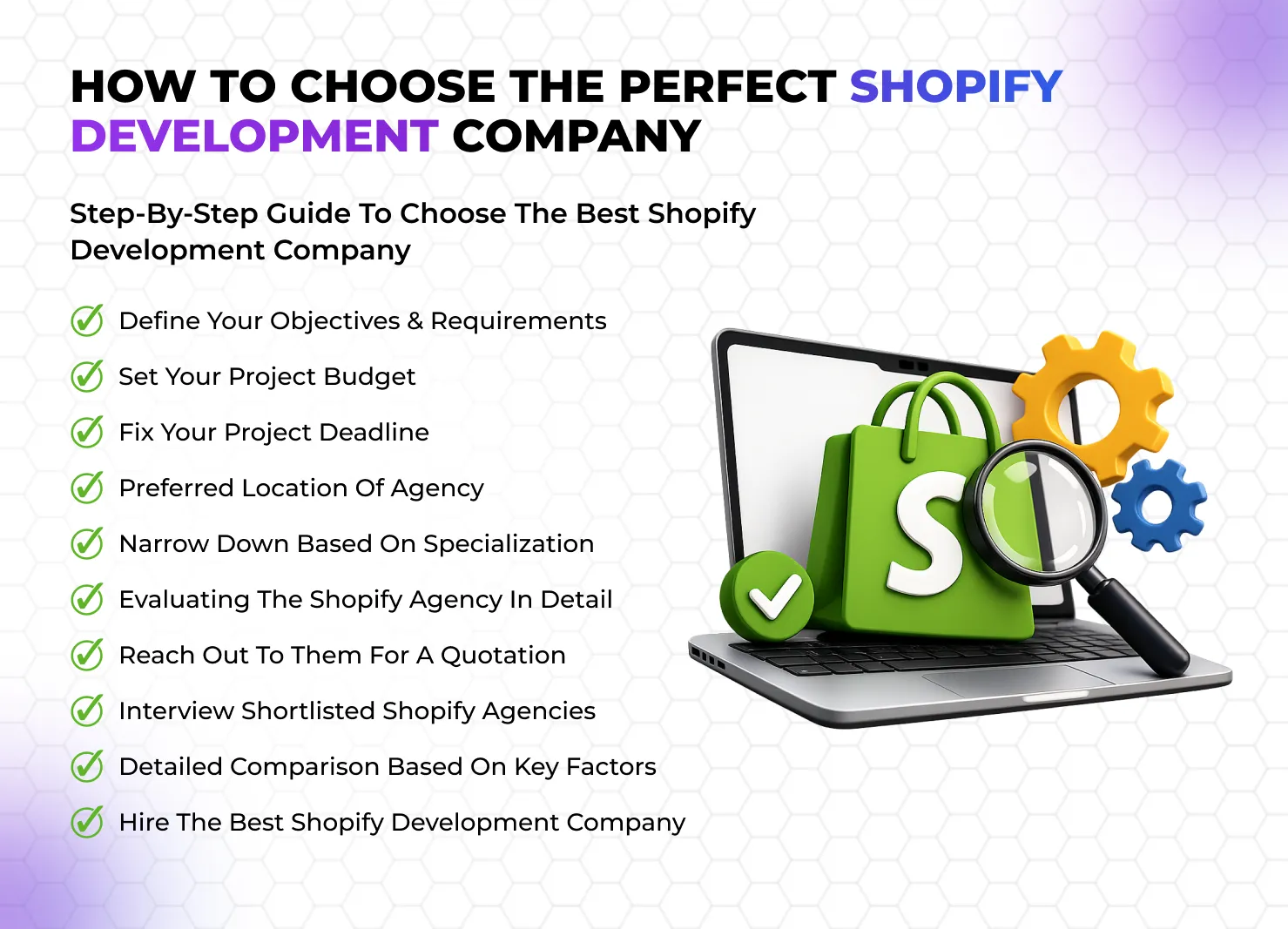
Now that you understand what agencies do, how to evaluate expertise, what services to expect, and what costs look like, the question of how to actually make the selection decision becomes much more structured.
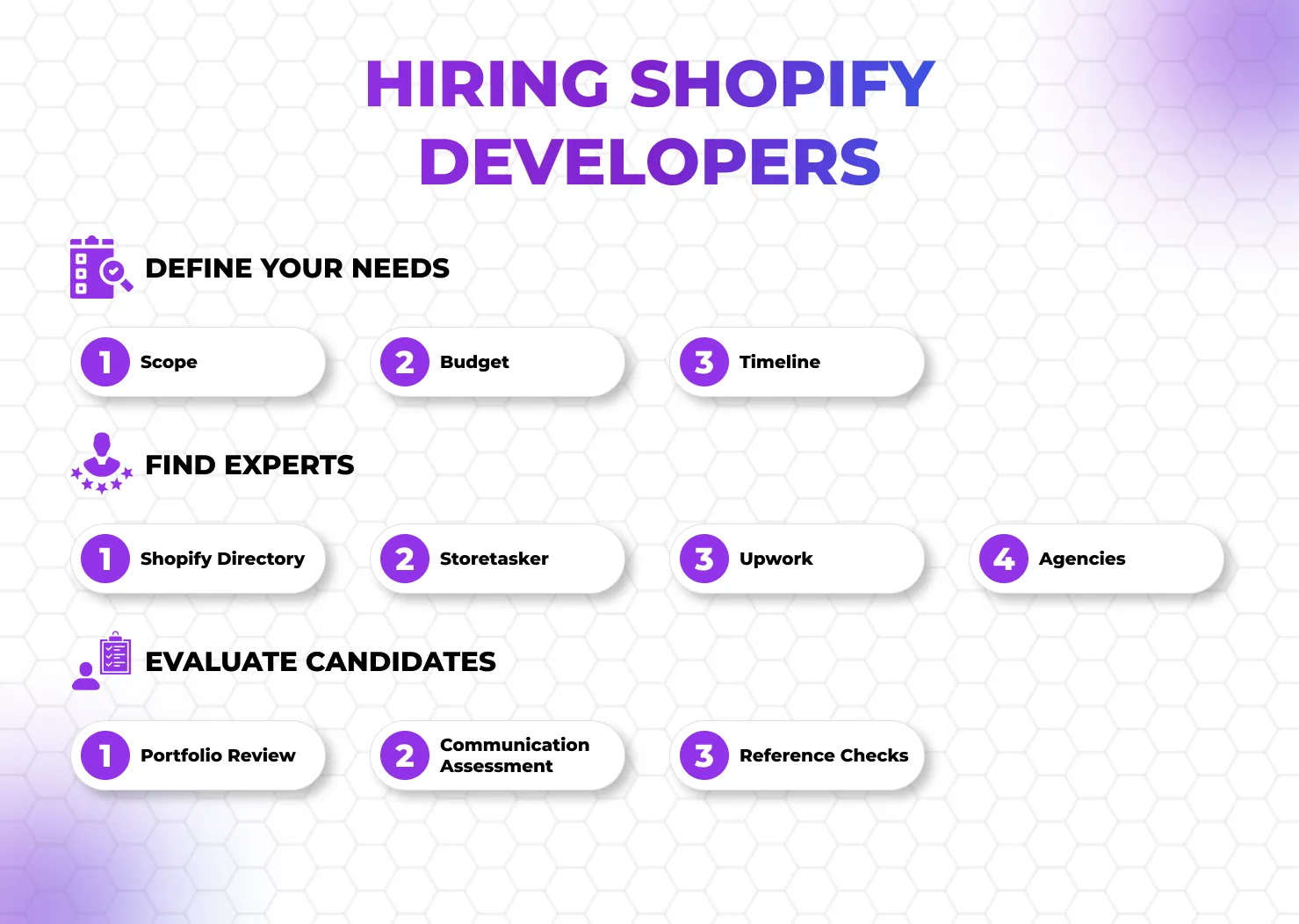
Defining Your Project Scope With Precision Before Approaching Any Agency
Businesses that go to agencies with vague briefs, “we need a Shopify store that looks good and converts well”, receive vague proposals back and end up comparing quotes that aren’t measuring the same things.
A precise brief covers your product catalogue size and complexity, your existing platform (if migrating), your must-have integrations (inventory system, CRM, email marketing platform), your design brief or references, your go-live timeline, and your budget range.
This brief becomes the filter that tells you immediately which agencies are equipped for your project and which aren’t.
Shortlist Based On Relevant Experience, Not General Capability
An agency that has built five outstanding stores for sustainable fashion brands understands your customer psychology, the visual language that converts in that space, and the specific app integrations that matter for lifestyle product businesses.
That contextual experience is more valuable than a generalist agency with a larger portfolio of unrelated verticals.
Ask every shortlisted agency for case studies from projects most similar to yours, in industry, in project complexity, and in outcome type.
Check Their Shopify Partner Tier As An Independent Benchmark.
Shopify’s tiered Partner Programme is a useful proxy for the breadth and depth of an agency’s platform experience.
A Select or Plus Partner has cleared specific commercial and client success thresholds. A Premier or Platinum Partner has done it at scale.
This doesn’t mean a Registered Partner can’t do excellent work, many smaller agencies at this tier produce outstanding outputs for specific project types, but the tier gives you context about the volume and complexity of Shopify work they’ve handled.
See Their Proposal
The proposal itself tells you a lot about an agency’s quality before a single line of code is written.
A strong proposal for a Shopify web development company project includes a clear understanding of your brief. It defines a structured project plan with defined phases and milestones, explicit deliverables at each stage, revision and approval processes. It has a realistic timeline, transparent pricing with itemised costs, and a post-launch support plan.
A weak proposal is vague, heavy on agency credentials and light on your specific project, and makes promises without a roadmap for how they’ll be delivered. Trust your instincts on this, the quality of the proposal reflects the quality of the work.
Ask The Questions That Reveal How They Work Under Pressure
How do you handle scope changes mid-project? What happens if we discover additional functionality is needed after the build begins? What’s your bug resolution process post-launch? Can we speak with two or three current or recent clients?
These questions make comfortable agencies more comfortable and expose agencies that haven’t thought through their own processes.
A great Shopify experts team welcomes these questions because they have clear, confident answers ready.
Assess Cultural And Communication Fit
E-commerce projects run anywhere from six weeks to six months or longer.
You’ll be in regular communication with this team throughout that time, sharing feedback, making decisions, and navigating the inevitable complications that arise in any serious build.
An agency whose communication style, working pace, and values are genuinely compatible with yours will deliver a better project outcome than a technically superior agency whose way of working creates constant friction. The technical capability has to be there, but so does the working relationship.
For businesses in Dubai specifically, the combination of platform expertise, regional market understanding, and responsive communication is worth prioritising over an agency with global name recognition.
But if an agency has no real understanding of the MENA e-commerce landscape, consumer behaviour in the region, or the operational context your business operates in, it cannot bring success to your brand.
5 Best Shopify Development Agencies in Dubai
Dubai has quickly become one of the most competitive ecommerce markets in the Middle East. Brands launching online stores here usually look for agencies that combine design thinking, development precision, and marketing awareness.
The challenge is that many teams claim Shopify expertise, but only a handful consistently deliver stores that actually perform well.
Based on industry reputation, technical capability, and project experience, here are five agencies businesses often consider when searching for reliable Shopify partners in Dubai.
1. The Meta Future
The Meta Future stands out as a strategic Shopify development agency focused on building ecommerce ecosystems rather than just online stores. Their approach combines development, UX design, and digital marketing thinking to create Shopify experiences that feel both visually compelling and commercially effective.
Instead of simply installing a theme, the team usually begins by understanding how the brand plans to grow. That insight shapes the store architecture, product storytelling, and conversion flow.
This process has proven particularly effective for brands operating in healthcare, sustainable products, coaching, and education, industries where product messaging and trust play a major role in purchasing decisions.
Clients working with this Shopify ecommerce development agency often appreciate the collaborative process.
Designers, developers, and strategists work together from the beginning so the final store doesn’t feel fragmented.
Another strength lies in technical flexibility. Beyond design and development, the team also handles integrations, performance improvements, and long-term optimization. Businesses looking for reliable Shopify web development services often value this combination of creative and technical expertise.
What makes their work noticeable is the balance between aesthetics and functionality. Stores look clean and modern, but they are also structured to guide visitors toward purchase decisions naturally.
2. Digital Gravity
Digital Gravity is a well-known Shopify web development company in Dubai with experience across ecommerce platforms. Their team works with both startups and established businesses looking to migrate or expand their online stores.
Their strength lies in full-service digital solutions. Alongside development, they also offer branding, marketing, and analytics services. This integrated model appeals to brands looking for a single partner to manage multiple aspects of their online presence.
For companies searching for structured Shopify web development services, Digital Gravity offers a solid balance between design capabilities and technical development.
3. Element8
Element8 has built a reputation in Dubai for high-end digital design and development projects. Their ecommerce work focuses heavily on visual presentation and user experience.
Brands that prioritize strong design identity often work with this Shopify website design company to create visually polished storefronts.
Their projects often include custom UI elements, interactive features, and modern layouts that help brands stand out visually. Businesses launching premium or lifestyle products often appreciate this design-forward approach.
4. GCC Marketing
GCC Marketing provides ecommerce development services for businesses across multiple industries. Their Shopify team focuses on building scalable stores that support long-term growth.
As a Shopify web development agency, they handle projects ranging from small product catalogs to larger ecommerce platforms with complex functionality.
Many businesses appreciate their structured development process, which includes planning, wireframing, development, and post-launch support. This systematic approach helps brands maintain stability as their store evolves.
5. Branex
Branex is another agency known for ecommerce development and digital product design. Their Shopify services often focus on startups and emerging brands looking to establish their first professional online store.
Their team includes developers, designers, and marketing specialists who collaborate throughout the project. Businesses searching for a reliable Shopify web designer to bring their product vision to life often consider Branex among their options.
Their work typically emphasizes clean layouts, mobile optimization, and simplified user journeys.
Conclusion
Selecting a Shopify development agency often feels overwhelming because many companies appear similar at first glance. Portfolios look polished, services sound impressive, and pricing ranges widely.
In practice, the difference emerges in how agencies approach problems.
Some teams simply build stores. Others help shape the entire ecommerce experience, from storytelling and design to performance and scalability.
Our work has shown that the most successful stores emerge from collaboration. Brands bring their vision and product knowledge. We bring the technical and strategic framework that transforms those ideas into a functioning online ecosystem.
For businesses exploring their next Shopify project, finding the right partner can dramatically shorten the path from launch to growth. A thoughtful approach to design, development, and optimization turns a simple storefront into a reliable sales engine.
And when that happens, ecommerce stops feeling like a technical challenge and starts behaving like a real business opportunity.